
Teaching
Courses
GEOG 331: Geomorphology
Planetary surfaces are shaped by physical, chemical, and biological processes involving complex feedbacks and spanning a range of subaerial and subaqueous environments. In this undergraduate level course, students investigate these surface processes and their impact on the spatiotemporal evolution of planetary surfaces.
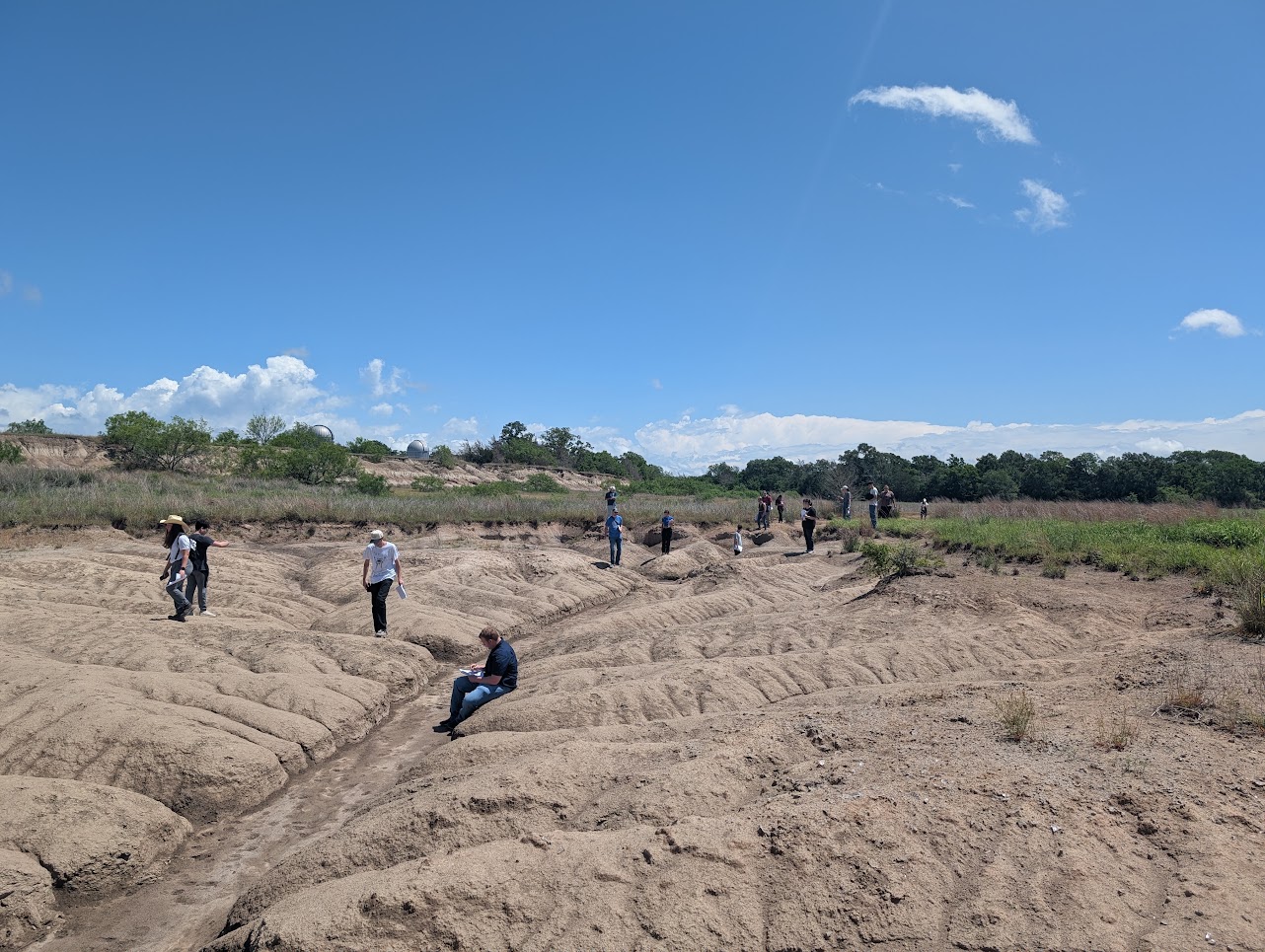
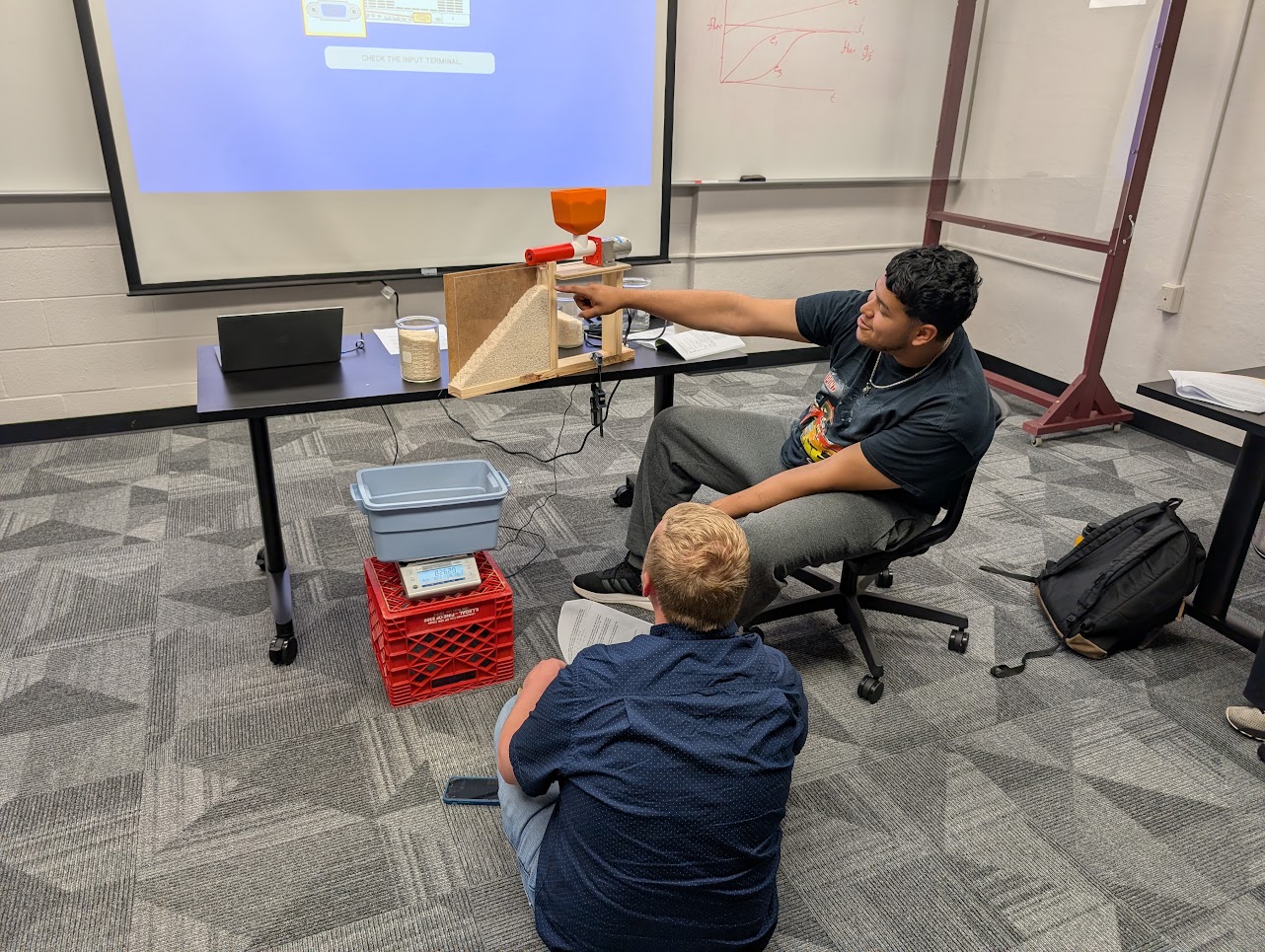
This course has a lab section, which includes programming modules, field visits, and analytical activities that support students in developing thier intuition for surface processes. For example, when learning about sediment transport, students are asked to develop a Python code that predicts the settling velocity for a particle of a particular size \(D\), given a published formula (Ferguson & Church, 2004).
def calculate_particle_setting_velocity(D):
    """Particle settling velocity [m/s]
    """
    C1, C2 = 18, 1  # constants in Ferguson-Church equation
    rhop, rhof = 2650, 1000  # particle and fluid density
    R = (rhop-rhof)/rhof     # particle specific density
    g, nu = 9.81, 1.002e-6   # gravitational constant and fluid kinematic viscosity
    w = ((R*g*D**2)/(C1*nu + (0.75*C2*R*g*D**3)**0.5))

    return w
ENSS 105: Introduction to Environmemntal Systems Science
This introductory course for majors in the Environmental Programs teaches concepts and generalizations of global environmental issues within an Earth systems science framework including climate change, air pollution, land and coastal degradation, water resources and pollution, and habitat loss.
GEOG 698: Sediment Transport and Morphodynamics
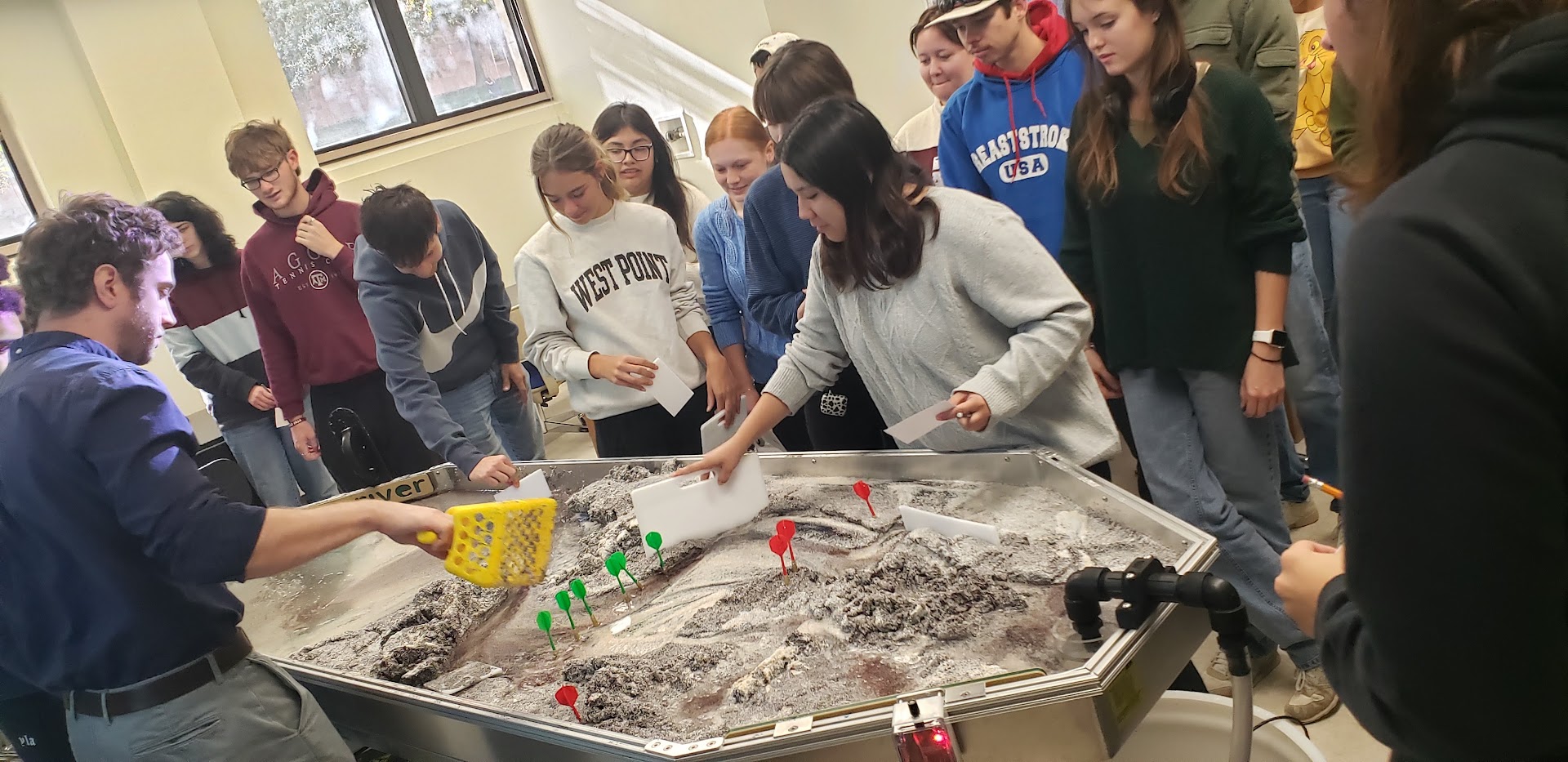
Taught as a special topics graduate course, this course covers concepts and methods in sediment transport and morphodynamics. Assigned readings and homeworks cover topics including environmental fluid mechanics, turbulence, critical thresholds of motion, modes of sediment transport, bedforms, sediment gravity flows, coastal morphodynamics, and aeolian transport.
Incorporating computer based “active learning”
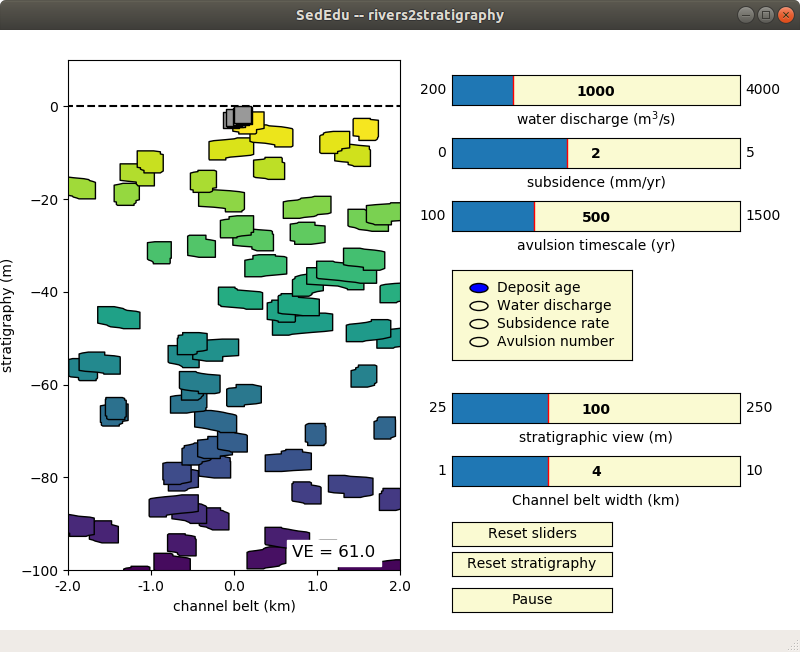
Active learning strategies improve student exam performance, engagement, attitudes, thinking, writing, self-reported participation and interest, and help students become better acquainted with one another (Prince, 2004). I am committed to using active learning approaches in the classrooms I lead. In particular, I am developing a comprehensive suite of interactive computer-based activities for sedimentology and stratigraphy courses (SedEdu).
The figure at right is the rivers2stratigraphy activity, which illustrates basin-scale development of fluvial stratigraphy through adjustments in system kinematics including sandy channel migration and subsidence rates. The activity allows users to change these system properties, so as to drive changing depositional patterns.
Relevant peer-reviewed publications
- Moodie, A., Carlson, B., Foreman, B., Kwang, J., Naito, K., & Nittrouer, J. (2022). SedEdu: software organizing sediment-related educational modules. Journal of Open Source Education, 5(56), 129. doi: 10.21105/jose.00129
References
Ferguson, R. I., & Church, M. (2004). A Simple Universal Equation For Grain Settling Velocity. Journal of Sedimentary Research, 6(3).
Prince, M. (2004). Does Active Learning Work? A Review of the Research. The Research Journal for Engineering Education, 93(3), 223–231. doi: 10.1002/j.2168-9830.2004.tb00809.x